- Key findings from the October 2026 FastExpert agent survey:
- What is the average real estate commission?
- Average real estate commission by state
- States with the highest and lowest real estate commissions
- Real estate commission to sell your house
- Real estate commission to buy a house
- Are real estate commissions negotiable?
- How has the NAR settlement affected real estate commissions?
- Discount brokerages: what agents think
- How real estate commissions are split and paid
- Real estate commission FAQ
- What is the average real estate commission in 2026?
- What is the average realtor commission for a listing agent?
- How much is the real estate commission to sell my house?
- How much is the real estate commission to buy a house?
- Is a 6% real estate commission still normal?
- What's the lowest commission an agent will accept?
- Which state has the highest real estate commission?
- Which state has the lowest real estate commission?
- Do sellers still have to pay the buyer's agent?
- Can I negotiate my agent's commission?
- Is there a standard real estate commission rate?
- Are the state-by-state commission averages exact?
- Find an agent who's worth the commission
- About this survey
Real Estate Commission by State: 2026 Survey


Published by

Click here to browse our Real Estate Agent Directory and contact top-rated agents in your area!
NEW: 2026 FastExpert Real Estate Commission Survey
We surveyed 682 real estate agents across 50 states to find out what agents are actually charging and how commission structures are changing.
The average real estate commission in 2026 is approximately 5.84% of the sale price, according to FastExpert’s survey of 682 real estate agents across all 50 states and Washington, D.C. Listing agents stated they typically earn 3.01%, and buyer’s agents typically earn 2.84%. On a $400,000 home, that’s roughly $23,380 in total commission.
Those are typical negotiated rates. Commissions are not fixed by law, and compensation rates are negotiable. 91.5% of agents said they are willing or might be willing to negotiate, and the lowest rate most would accept is 2.0%–2.49% per side of the transaction.
Key findings from the October 2026 FastExpert agent survey:
- 5.84% average total commission (3.01% listing + 2.84% buyer’s agent)
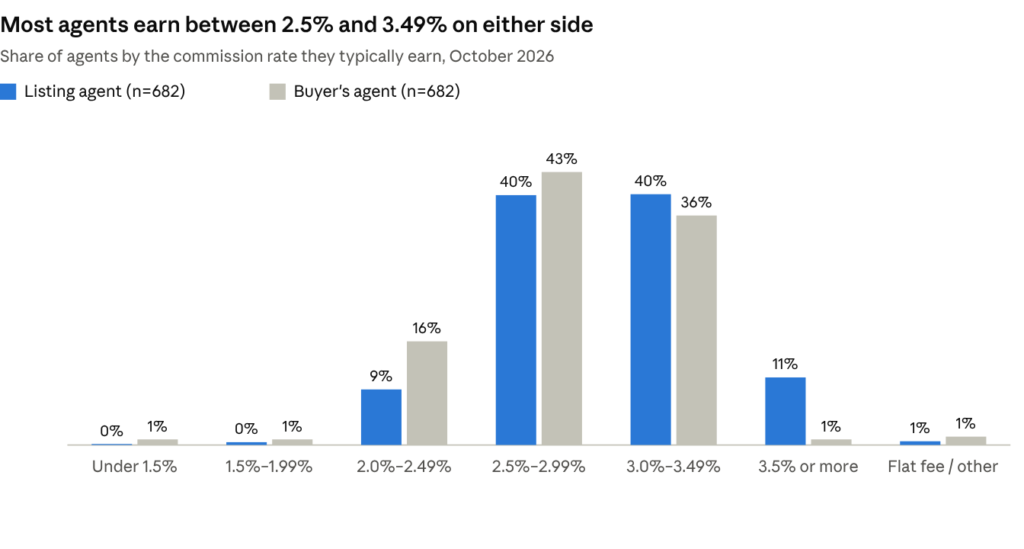
- 50.4% of listing agents typically earn 3% or more; 39.6% earn 2.5%–2.99%
- 2.5%–2.99% is the most common buyer’s agent rate (43.3% of agents)
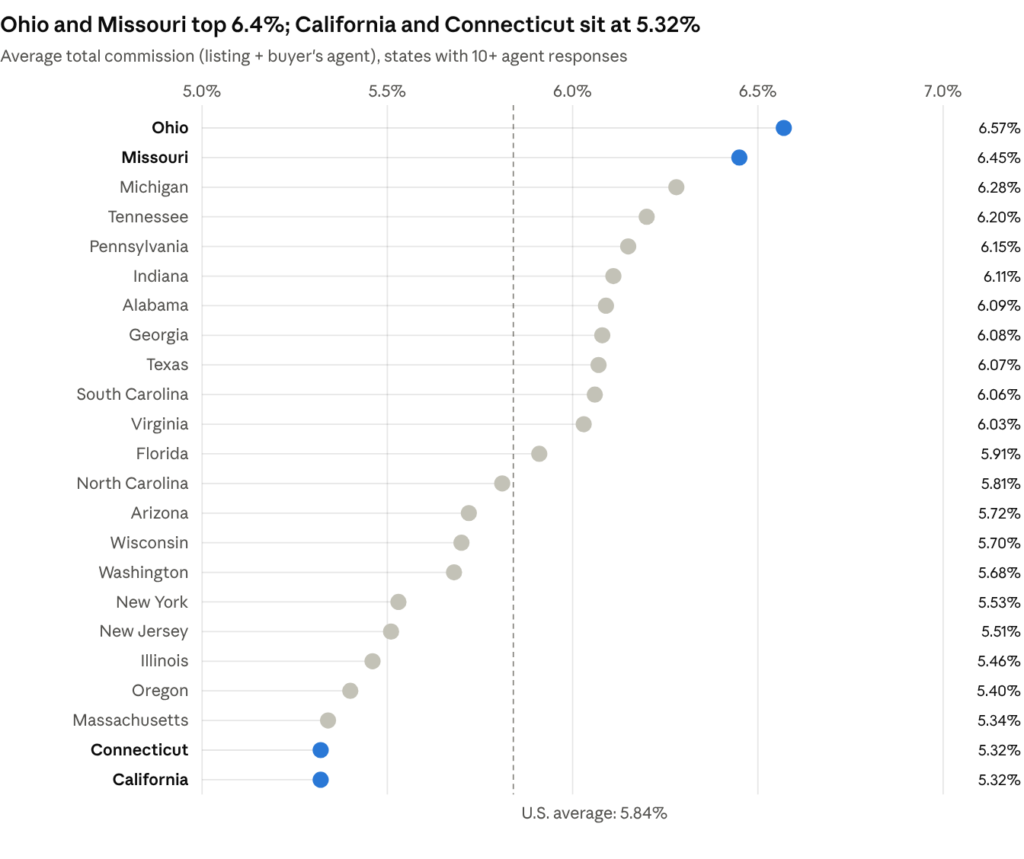
- Ohio (6.57%) and Missouri (6.45%) have the highest averages among states with 10+ responses; California and Connecticut (5.32%) have the lowest
- 86.4% of agents say the seller still usually pays the buyer’s agent, two years after the NAR settlement
- 58.5% say their pay has stayed about the same since the NAR settlement; 18.4% say it went down and 15.8% say it went up
- Survey respondents average 19.8 years of experience in real estate, and 96.5% work full time
Below you’ll find the full state-by-state table, what it costs to sell or buy a house, how negotiable commissions really are, and what agents told us in their own words.
What is the average real estate commission?
The average real estate commission is 5.84% of the home’s sale price, split between a 3.01% listing agent commission and a 2.84% buyer’s agent commission. That’s the commission agents say they typically negotiate and are paid, based on 682 survey responses.
Most agents cluster in a narrow band. About 80% of listing agents and 80% of buyer’s agents typically earn between 2.5% and 3.49%. Listing agents lean higher: 10.7% earn 3.5% or more, versus under 1% of buyer’s agents.
FastExpert agent survey, Sept. 14–Oct. 27, 2026 · 682 agents
| Commission | Average rate | On a $300,000 home | On a $400,000 home | On a $600,000 home |
|---|---|---|---|---|
| Listing agent (seller’s side) | 3.01% | $9,020 | $12,030 | $18,040 |
| Buyer’s agent | 2.84% | $8,510 | $11,350 | $17,030 |
| Total | 5.84% | $17,530 | $23,380 | $35,070 |
Dollar figures use unrounded survey averages, so they may differ slightly from multiplying the rounded rates.
The total commission doesn’t all go to one person. It’s usually split between the listing brokerage and the buyer’s brokerage, and each agent then splits their share with their broker. More on that below.
Average real estate commission by state
Average real estate commission by Region.
Average total commissions range from about 5.3% to 6.6% depending on the state. The Midwest has the highest rates and the West has the lowest:
| Region | Listing agent | Buyer’s agent | Total | Agents surveyed |
|---|---|---|---|---|
| Midwest | 3.17% | 3.00% | 6.17% | 111 |
| South | 3.05% | 2.94% | 5.99% | 281 |
| Northeast | 2.97% | 2.63% | 5.61% | 137 |
| West | 2.83% | 2.73% | 5.56% | 153 |
Average real estate commission by State.
Use the table below to find the average real estate commission in your state. The dollar column shows total commission on a $400,000 sale.
| State | Listing agent | Buyer’s agent | Total commission | Total on $400K home |
|---|---|---|---|---|
| Alabama | 3.25% | 2.84% | 6.09% | $24,360 |
| Alaska* | 3.25% | 2.75% | 6.00% | $24,000 |
| Arizona | 2.87% | 2.86% | 5.72% | $22,890 |
| Arkansas | 3.32% | 3.04% | 6.36% | $25,430 |
| California | 2.73% | 2.59% | 5.32% | $21,260 |
| Colorado | 2.97% | 2.86% | 5.83% | $23,330 |
| Connecticut | 2.75% | 2.57% | 5.32% | $21,270 |
| Delaware* | 2.75% | 2.75% | 5.50% | $22,000 |
| Florida | 3.03% | 2.88% | 5.91% | $23,630 |
| Georgia | 3.10% | 2.98% | 6.08% | $24,310 |
| Hawaii* | 2.92% | 2.92% | 5.83% | $23,330 |
| Idaho* | 3.00% | 3.00% | 6.00% | $24,000 |
| Illinois | 2.75% | 2.71% | 5.46% | $21,860 |
| Indiana | 3.04% | 3.07% | 6.11% | $24,440 |
| Iowa | 3.33% | 3.17% | 6.50% | $26,000 |
| Kansas | 3.05% | 3.25% | 6.30% | $25,200 |
| Kentucky | 3.05% | 3.05% | 6.10% | $24,400 |
| Louisiana | 2.82% | 2.89% | 5.71% | $22,860 |
| Maine* | 3.42% | 2.75% | 6.17% | $24,670 |
| Maryland | 2.88% | 2.88% | 5.75% | $23,000 |
| Massachusetts | 2.81% | 2.53% | 5.34% | $21,380 |
| Michigan | 3.23% | 3.05% | 6.28% | $25,100 |
| Minnesota | 3.18% | 2.92% | 6.10% | $24,380 |
| Mississippi | 3.25% | 2.83% | 6.08% | $24,330 |
| Missouri | 3.30% | 3.15% | 6.45% | $25,800 |
| Montana* | 2.75% | 2.75% | 5.50% | $22,000 |
| Nebraska* | 3.75% | 2.25% | 6.00% | $24,000 |
| Nevada | 2.75% | 2.95% | 5.70% | $22,800 |
| New Hampshire | 2.75% | 2.55% | 5.30% | $21,200 |
| New Jersey | 2.92% | 2.59% | 5.51% | $22,040 |
| New Mexico | 3.15% | 3.15% | 6.30% | $25,200 |
| New York | 3.03% | 2.50% | 5.53% | $22,120 |
| North Carolina | 2.98% | 2.83% | 5.81% | $23,230 |
| North Dakota* | 3.00% | 2.75% | 5.75% | $23,000 |
| Ohio | 3.40% | 3.16% | 6.57% | $26,260 |
| Oklahoma | 3.00% | 3.12% | 6.12% | $24,500 |
| Oregon | 2.75% | 2.65% | 5.40% | $21,600 |
| Pennsylvania | 3.19% | 2.96% | 6.15% | $24,580 |
| Rhode Island* | 2.92% | 2.75% | 5.67% | $22,670 |
| South Carolina | 3.04% | 3.01% | 6.06% | $24,240 |
| South Dakota* | 3.25% | 3.25% | 6.50% | $26,000 |
| Tennessee | 3.15% | 3.05% | 6.20% | $24,800 |
| Texas | 3.05% | 3.02% | 6.07% | $24,300 |
| Utah | 3.08% | 3.00% | 6.08% | $24,330 |
| Vermont* | 3.25% | 3.25% | 6.50% | $26,000 |
| Virginia | 3.04% | 2.99% | 6.03% | $24,110 |
| Washington | 2.86% | 2.82% | 5.68% | $22,710 |
| Washington, D.C.* | 3.75% | 2.75% | 6.50% | $26,000 |
| West Virginia* | 2.75% | 2.62% | 5.38% | $21,500 |
| Wisconsin | 3.10% | 2.60% | 5.70% | $22,800 |
| Wyoming* | 3.50% | 2.75% | 6.25% | $25,000 |
* Fewer than 5 agents responded from this state, so treat its average as directional. Totals use unrounded averages and may differ by 0.01% from adding the two columns. Regions follow U.S. Census Bureau definitions.
States with the highest and lowest real estate commissions
Ohio has the highest average real estate commission at 6.57%, followed by Missouri (6.45%) and Michigan (6.28%). California and Connecticut have the lowest at 5.32%, followed by Massachusetts (5.34%) and Oregon (5.40%). This ranking only includes states where at least 10 agents responded.
FastExpert agent survey, Sept. 14–Oct. 27, 2026 · 23 states with 10+ responses
The gap is real money. On a $400,000 home, the average Ohio seller and buyer pay about $5,000 more in combined commission than in California.
Why the difference? Lower-priced markets tend to carry higher commission percentages because agents do the same work for a smaller sale price.
“Home price” was the No. 1 factor agents said shapes their rate (49.6% of agents). High-cost, competitive markets like California, Massachusetts, and the New York and New Jersey metros put more downward pressure on percentages. New York also stands out for its low buyer’s agent rate (2.50%), well below its 3.03% listing rate.
Highest commission states (10+ responses): Ohio 6.57% · Missouri 6.45% · Michigan 6.28% · Tennessee 6.20% · Pennsylvania 6.15%
Lowest commission states (10+ responses): California 5.32% · Connecticut 5.32% · Massachusetts 5.34% · Oregon 5.40% · Illinois 5.46%
Real estate commission to sell your house
If you’re selling, plan on paying your listing agent about 3.01% of the sale price. In most transactions, you’ll also pay the buyer’s agent: 86.4% of agents told us the seller still typically covers buyer-agent compensation. That puts a typical seller’s total at about 5.84%, or $23,380 on a $400,000 home.
Since the August 2024 NAR settlement, paying the buyer’s agent is a choice, not a rule. Sellers decide whether to offer it, and buyers negotiate their own agent’s pay in a written agreement. In practice, most sellers still offer it because it helps attract buyers.
“The biggest misconception is that a lower commission automatically means you net more. Sellers focus on the fee and forget the sale price. If a discount agent underprices your home, skips the prep, or folds in a negotiation, you can lose far more than you saved. The number that matters isn’t what you pay your agent. It’s what you walk away with at closing.”
— Kip Barnard, Compass, San Jose, CA
What a seller pays at the average rate:
| Sale price | Listing agent (3.01%) | Buyer’s agent (2.84%) | Total if seller pays both | Total if seller pays listing side only |
|---|---|---|---|---|
| $250,000 | $7,520 | $7,090 | $14,610 | $7,520 |
| $400,000 | $12,030 | $11,350 | $23,380 | $12,030 |
| $600,000 | $18,040 | $17,030 | $35,070 | $18,040 |
| $1,000,000 | $30,070 | $28,380 | $58,450 | $30,070 |
Ways sellers can lower their commission:
Ask. 55.0% of agents said they’re willing to negotiate, and another 36.5% said maybe. Only 8.5% said no.
Know the floor. Most agents’ lowest acceptable listing rate is 2.0%–2.49% (48.6% of agents who answered). The average floor is about 2.35%.
Ask about flat fees. 18.2% of agents offer a flat-fee option.
Confirm what’s included. 65.9% of agents say they never cut services when they discount, but 11.7% do, and 22.4% sometimes do. Get the marketing plan in writing.
Compare several agents. Rates, services, and track records vary widely, even within the same city.
Buyer-agent compensation can also be a selling tool. In some buyer’s markets, sellers are offering more to stand out:
“Buyer-Broker Compensation in our market has increased from averaging 2.25% then, to 2.75% now. This is mostly due to the nature of the market, sellers value having their home sell in a buyers’ market, so they are agreeing to pay a higher Buyer-Broker Compensation to incentivize the sale.”
— Rick Ruiz, Signature Real Estate Group, Las Vegas, NV
Real estate commission to buy a house
The average buyer’s agent commission is 2.84%, and the most common rate is 2.5%–2.99% (43.3% of agents). Another 36.4% typically earn 3.0%–3.49%, and 16.4% earn 2.0%–2.49%.
Who pays the buyer’s agent?
In most transactions, the seller still pays the buyer’s agent: 86.4% of agents said so. But no rule requires it. Who pays is set by the buyer’s written agreement and what the seller agrees to offer.
For buyers, that means you usually don’t pay your agent’s fee out of pocket. Here’s how agents described who typically pays:
| Who pays the buyer’s agent | Share of agents |
|---|---|
| The seller | 86.4% |
| It varies by transaction | 8.8% |
| Seller and buyer split it | 2.2% |
| The buyer | 0.7% |
Based on 588 agents who answered this question.
What changed after the NAR settlement is that buyers now sign a written buyer agreement before touring homes. That agreement states what your agent will be paid. If the seller offers less than that amount, you may owe the difference at closing, or you can ask the seller to cover it as part of your offer.
“Sellers don’t fully understand that if they refuse to pay a buyer’s agent commission, then that means the buyer will have to pay their own agent which reduces their buying power.”
— Kaden Monsebroten, Prime Realty, Fargo, ND
Skipping your own agent doesn’t automatically save money, either:
“The biggest misconception is that if a buyer goes directly to the listing agent, they automatically save the buyer’s agent commission. The fee is negotiated between the seller and the listing brokerage. An unrepresented buyer isn’t a party to that agreement, so there’s no automatic discount.”
— Dewayne Carpenter, Compass, Space Coast of Florida
In some markets, buyer’s agent pay has actually gone up since the settlement:
“Since the NAR lawsuit two years ago, listing agent commission rates have stayed about the same. However, buyer agent commissions have increased in Central IN.”
— Kyle Williams, Compass, Central Indiana
Tips for buyers:
- Read the buyer agreement before you sign it, and ask how your agent’s fee will be paid.
- Ask whether the seller is offering buyer-agent compensation on each home you like.
- If there’s a gap, ask your agent to request it from the seller in your offer, or negotiate a seller credit.
- Negotiate the fee up front. Most buyer’s agents (91.5% of all agents surveyed) are open to it.
Are real estate commissions negotiable?
Yes. Commissions are always negotiable, and 91.5% of agents said they are willing (55.0%) or might be willing (36.5%) to negotiate their rate. Yet most clients never ask: only about a third of agents say clients negotiate at least half the time.
| How often clients negotiate commission | Share of agents |
|---|---|
| Almost always | 4.8% |
| Frequently | 11.7% |
| About half the time | 15.3% |
| Occasionally | 49.1% |
| Almost never | 19.0% |
Based on 588 agents who answered this question.
“I wish buyers and sellers understood that real estate commissions are not fixed and are always negotiable. An agent’s compensation pays for much more than opening doors or putting a sign in a yard.”
— Joe Luca, RE/MAX Preferred, North Providence, RI
Questions to ask before you sign an agreement
- What services are included in your commission, and what costs extra?
- Do you offer different service packages or fee structures, such as a flat fee?
- What happens if my home doesn’t sell or the deal doesn’t close?
- How will buyer-agent compensation be handled, and who pays it under this agreement?
- Can I end the agreement early, and are there any fees if I do?
What determines an agent’s commission rate
Agents were asked: What affects your negotiated commission rate? They could choose any applicable factor. Home price and the type of representation topped the list.
| Factor | Share of agents |
|---|---|
| Home price | 49.6% |
| Whether the client is buying, selling, or both | 48.4% |
| Complexity of the transaction | 33.5% |
| Expected level of service | 33.2% |
| Type of property | 32.1% |
| Competition from other agents | 25.4% |
| Location / market | 25.2% |
| Services included | 23.0% |
| Client’s willingness to negotiate | 21.9% |
“Rates are always negotiable, but top-tier agents who deliver higher net proceeds, smoother transactions, and stronger contract protection continue to command standard rates because the results speak for themselves.”
— Shawn Hartmann, RE/MAX, St. Paul, MN
How has the NAR settlement affected real estate commissions?
The August 2024 NAR settlement didn’t set or cap commission rates. It changed how buyer-agent pay is offered and documented. Offers of buyer-agent compensation no longer appear on the MLS, and buyers must sign a written agreement with their agent before touring homes.
For most agents, pay has held steady.
58.5% said their typical compensation stayed about the same over the past two years, 18.4% said it decreased, and 15.8% said it increased. Another 15.5% said they’re negotiating more often.
Agents were nearly split on whether the NAR settlement changed how they structure their pay: 50.9% said no, 45.4% said yes.
What changed most is the conversation. Local trends also vary a lot:
“In the Southern Maine market, I’m seeing much more awareness and conversation around compensation than I did a few years ago. Consumers are asking better questions, and agents are having more detailed conversations about their fees, services, and value upfront.”
— Kimberly Tarbox, FIV Realty Maine, Portland, ME
“Our market is pretty consistent with sellers offering a buyer’s agent commission but in the past it averaged around 2.5% and now most are only offering 2% to a buyer’s agent.”
— Kim Gero, BHHS Verani Realty, Wolfeboro, NH
“We actually have seen our average commission rate get closer to 6% rather than move in the other direction.”
— Jon Bowling, Cincinnati, OH
“The compensation on the listing side is still strong, but sellers are less inclined to offer buyer’s agent compensation.”
— Lester A. Salazar, Coldwell Banker Island Properties, Mililani, HI
Discount brokerages: what agents think
Most agents are skeptical of discount brokerages. 54.4% called discount brokerage sites harmful to the industry, 42.9% were indifferent, and 2.7% called them helpful.
The most common concern was service: several agents said the other side’s agent ends up doing extra work when a discount broker is involved.
“There is no one-size-fits-all commission rate. Compensation is negotiable and can vary based on the services provided, the property, the real estate professional, the brokerage, and the transaction. Consumers should look beyond the percentage and understand the representation, expertise, and services they are receiving for that compensation.”
— Vicky Santana, Broker/Owner, NextHome Santana Real Estate, Indian River County, FL
How real estate commissions are split and paid
Commission is paid at closing, usually out of the seller’s proceeds, and only if the sale closes. 87.7% of agents say a percentage of the purchase price is still the most common structure in their market; 11.4% say pay varies and is negotiated deal by deal.
Here’s how a typical commission moves from the closing table to the agent:
- The total is set. The seller agrees to pay the listing brokerage, and may offer compensation to the buyer’s brokerage. The buyer’s agreement sets what their agent is owed.
- The brokerages are paid. At closing, the title or escrow company pays each brokerage, not the individual agents.
- Each brokerage pays its agent. The agent gets a share based on their split with the broker. Team fees and referral fees can come out too.
- The agent covers business costs. Marketing, photography, MLS and association dues, licensing, insurance, and self-employment taxes come out of the agent’s share.
Example: On a $400,000 sale, the listing side earns about $12,030. If the agent’s split with their broker is 80/20, the agent receives about $9,620 before expenses and taxes. That’s roughly 2.4% of the sale price, not 6%.
“Our broker takes 20 percent and Uncle Sam takes another 15.”
— Dave Berry, Realty87, Cedar Rapids, IA
“A common misconception is that the commission is the agent’s take-home pay. In reality, agents have significant business expenses, including marketing, MLS and brokerage fees, insurance, and other costs of running their business.”
— Mary Renn, Tierra Antigua Realty, Sierra Vista, AZ
Agents also carry the risk of unpaid work. If a deal falls apart, they typically earn nothing for the time already spent.
“A real estate agent does not get paid until closing even though the commitment and the work begins well before that. If a house doesn’t close, an agent does not get paid and has then worked for months and months with no compensation.”
— Linda Jennings, Berkshire Hathaway HomeServices Verani, Salem, NH
Real estate commission FAQ
What is the average real estate commission in 2026?
The average real estate commission is 5.84% of the sale price, based on FastExpert’s October 2026 survey of 682 agents. That’s about 3.01% for the listing agent and 2.84% for the buyer’s agent.
What is the average realtor commission for a listing agent?
Listing agents earn an average of 3.01%. Half (50.4%) typically earn 3% or more, and 39.6% earn 2.5%–2.99%.
How much is the real estate commission to sell my house?
Plan on about 3% for your listing agent. If you also offer buyer-agent compensation, as most sellers do, your total will be about 5.84%, or $23,380 on a $400,000 home.
How much is the real estate commission to buy a house?
Buyer’s agents earn an average of 2.84%. 86.4% of agents say the seller usually pays it. If the seller doesn’t, the buyer may pay some or all of it under the buyer agreement.
Is a 6% real estate commission still normal?
Six percent is now on the high end. The national average is 5.84%, and states range from about 5.3% to 6.6%. Ohio, Missouri, Iowa, and Michigan are among the states where totals near or above 6% are common.
What’s the lowest commission an agent will accept?
Most agents won’t go below 2.0%–2.49% per side; that’s the floor for 48.6% of agents who answered. About 17.7% would go below 2%.
Which state has the highest real estate commission?
Among states with at least 10 survey responses, Ohio has the highest average total commission at 6.57%, followed by Missouri at 6.45%.
Which state has the lowest real estate commission?
California and Connecticut tie for the lowest at 5.32%, followed by Massachusetts at 5.34%.
Do sellers still have to pay the buyer’s agent?
No. Since the 2024 NAR settlement, offering buyer-agent compensation is optional. But most sellers still do: 86.4% of agents said the seller typically pays.
Can I negotiate my agent’s commission?
Yes. Clients can always ask for a negotiated commission rate. 91.5% of agents said they are willing or might be willing to negotiate. Ask before you sign a listing or buyer agreement, and get any reduced rate and the services included in writing.
Is there a standard real estate commission rate?
No. Commissions are not fixed by law, and there is no standard rate. The typical total in our survey is 5.84%, but every commission is negotiated between the client and the agent, and rates vary by state, price, and services.
Are the state-by-state commission averages exact?
No. They are averages of what surveyed agents reported, not official state figures. Some states had few responses, and those are marked with an asterisk in the table. Use them as a guide for your conversation with an agent, not as a price list.
Find an agent who’s worth the commission
The rate is only half the equation. The other half is what the agent delivers: the sale price, the terms, and a clean closing. FastExpert compares local agents on verified sales, reviews, and experience so you can interview the right ones and negotiate with confidence. Find a top-rated agent near you.
About this survey
FastExpert surveyed 682 licensed real estate professionals between September 14 and October 27, 2026. Respondents work in all 50 states and Washington, D.C. They average 19.8 years in the business, and 96.5% work full time.
- How averages were calculated: Agents chose a commission range (for example, 2.5%–2.99%). We used each range’s midpoint (2.75%) and “3.5% or more” as 3.75%, then averaged the results. Agents who use a flat fee or other structure were excluded from rate averages.
- What the rates mean: These are the rates agents say they typically negotiate and are paid. Commissions are never fixed; each one is negotiated with the client, so individual transactions vary.
- State results: States with fewer than 5 responses are marked and should be read as directional. Highest and lowest rankings include only states with 10 or more responses.
- Percentages: Each question’s percentages are based on the agents who answered it. Some questions allowed more than one answer.
- Quotes: Agent quotes are used with permission from respondents who asked to be considered for a quote. Some are lightly edited for length and spelling.
Published by FastExpert. You may cite this data with a link to this page.
Published by